
Materiality is too often treated primarily as a reporting activity, a box ticked on the way to disclosure. It should be one of the most strategic decisions an organisation makes, and a management tool to be used continually rather than completed once, an ongoing choice about what matters most, and about what the organisation most affects. Get it right, and strategy, targets, engagement and disclosure all follow with far greater focus.

Is materiality the most misunderstood word in sustainability?
Most people treat it as a reporting activity. In practice, it is a strategic management step, but one too often mistaken for a mere disclosure requirement.
Part of the confusion is understandable. The reporting requirement is frequently what prompts an organisation to carry out its first materiality assessment, and there is nothing wrong with that as a trigger. The difficulty is that it quietly frames the whole exercise as something you do for the report, when the logic should be the reverse: strategy first, disclosure as one of the outputs.
This misunderstanding has a cost.
Organisations can end up reporting on forty things and prioritising none with the result that teams can stretch themselves thin across every possible issue. The materiality matrix, often genuinely well-constructed, goes into a report, ends up on a web page, sometimes three years out of date, and is quietly mistaken for a completed project.
But a materiality assessment was never meant to be a static output, and it is certainly not a ‘one and done’ task.
It’s a set of decisions, not a document
Strip away the reporting language and a materiality assessment is really a pool of intelligence and a record of a set of decisions; what matters most to your organisation, and what your organisation does, or causes to happen, that matters most to others.
Materiality assessment asks some fundamental questions – one question looks at the risks and opportunities coming towards you, the other looks at the impact you are having on the world around you. Keeping those two questions distinct is the first discipline of a good assessment; blur them and everything ends up in one flat list, with the genuinely significant issues crowded amongst the ‘potentially relevant’ ones.
(For what a materiality assessment actually involves — the tests, the double-materiality lenses, the methods, see our guide to materiality assessment → Materiality Matters).
Why it’s worth getting right
Get your materiality assessment right and everything that flows from it becomes more strategic, more relevant and more focused. Your goals, targets, engagement, disclosure and your wider communication.
Targets should stem from the issues that really matter. Budget conversations get easier, because you have already decided what is important and, just as importantly, what is not. Materiality done properly is as much a record of what you will stop doing as it is a description of where you will concentrate effort and resources.
This is the part most often lost when materiality is treated as a purely procedural exercise. A prioritisation that never leaves the report cannot shape a strategy, inform a budget, or direct a team’s attention. A prioritisation that exists not just as part of reporting but of strategic sustainability management becomes the backbone the whole sustainability approach is built on, the reference point that a well-defined sustainability ambition and focused strategy depends upon.
Never really finished
Perhaps the most damaging assumption about materiality is that, once done, it is done.
It is not. Materiality is a strategic management tool, and like any management tool it earns its value through use, not simply through existence. A reporting requirement may prompt your first assessment, but several different things should prompt you to revisit it. These include time elapsing, a material change in the business, or a shift in the wider market or world around you. Between those points, your material issues need continuing, board-level attention. The question a board should keep asking itself is not “have we done our materiality assessment?” but “are we managing what matters, and do our current priorities still matter?”
Materiality Connections – upwards and outwards
A materiality assessment is only ever as valuable as what it connects to within an organisation’s approach and activities, and it should connect in two directions at once.
It connects upwards, into strategy and management. The findings carry strategic implications that should shape goals, targets, risk management and where resources go. This is where the real value sits. And it also connects outwards, into disclosure and communication, demonstrating to investors, regulators and customers that you recognise your impacts and responsibilities, and can account for them. This is also increasingly important for assurance, for example, ISSA 5000 requires evaluation of the materiality assessment process, its rationale and scope.
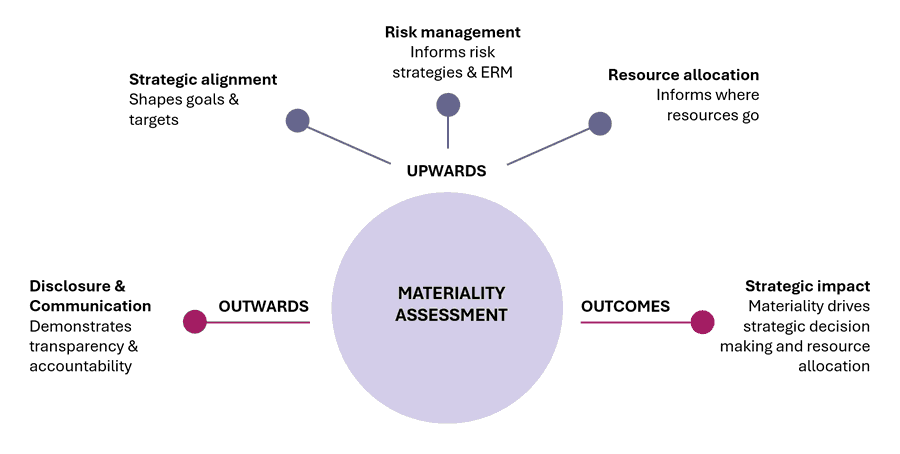
In practice, there can be a tension between the two. It is one thing to disclose that an issue is material, but another to accept what that means. That might include changing a priority, investing differently, or stopping doing something that no longer earns its place. A riskier path of least resistance is to deal with materiality as a sub-strategic response, to treat the assessment as something to be reported rather than acted upon. An assessment that only ever connects outwards satisfies the disclosure requirement while leaving most of its value on the table.
The question behind every framework
From a reporting perspective, materiality is also the single decision that nearly every framework is really asking you to make. UK SRS S1, ESRS, IFRS S1 and S2, GRI, the new B Corp standards and ISO 14001 differ in language and purpose, but underneath they ask the same thing: of everything you could focus on, what really counts, why, and to whom?
Get that call right and you are not running five assessments against five frameworks, you are running one, and letting each framework draw from it. The alternative, treating every framework as a separate exercise, is one of the surest routes to an exhausted sustainability team that is no clearer about its priorities than when it began.
Simpler rules, sharper judgement
Aren’t the standards simplifying and converging? Some are, to an extent. Recent reforms have narrowed the scope of mandatory reporting and cut the number of required data points considerably. It is tempting to read that as materiality mattering less. However, the opposite is closer to the truth. When there is a long, prescriptive set of impacts, risks and opportunities to hide behind, weak prioritisation goes unnoticed. When the list gets shorter, and materiality becomes the primary filter for what you report, judgement is fully exposed. While some regimes simplify, others are moving the other way. The latest B Corp standards now place materiality assessment at the heart of certification for larger organisations. The direction of travel is towards materiality as an exercise of management judgement.
In conclusion
The shift that matters here is not a technical one, it is one of mindset. Materiality is not the box you tick before reporting. It is the thinking, and the organisational infrastructure behind it, that the report is meant to reflect. Treated as compliance, it produces an output. Treated as strategy, it produces focus, a clear, defensible account of what your organisation will prioritise, why, and perhaps also what it will stop doing.
Of everything a sustainability team does, deciding what genuinely matters, both to the organisation and to the world it affects, is perhaps the most strategic decision of all. Done well, and revisited as the business and its context changes, it shapes strategy, sharpens targets, focuses resources, and gives communication something substantial to stand on.
Therefore, it is important to look beyond compliance. Materiality assessment is a strategic management tool, one that connects what you decide to what you do, and to what you disclose. It deserves to be treated as one.
If you are planning or refreshing a double materiality assessment, or want your sustainability strategy to rest on genuine priorities rather than a long list, we are always happy to talk — and if we can’t help, we’ll say so.

 Communicating future ambition and net zero – how to avoid greenwashing
Leave a Reply