
Changing regulation, political pressure and rising customer expectations are reshaping how organisations communicate sustainability. In this article, we explore where disclosure is retreating, where scrutiny is intensifying and what this means across seven sectors – with practical guidance and a stress test to help you assess whether your strategy’s narrative and evidence stand up.


ON THIS PAGE
This is a long article; you can use these links to navigate it.
What has changed since 2024 >>
Where communication is softening >>
Where communication is strengthening and refocusing >>
What good practice looks like now >>
- 1. Food and drink
- 2. Packaging
- 3. Law
- 4. Construction and property
- 5. Energy generation
- 6. Charities and NGOs
- 7. Advertising and marketing
If you ask how organisations are communicating sustainability strategy at the end of 2026 you might receive two apparently contradictory answers. Typically, companies are saying less, there’s been a tendency to tone down purpose-related language, social and diversity commitments and headline net zero pledges – especially in firms with US exposure. Yet at the same time, what they do say is being held to a higher standard of scrutiny, by regulators, by investors and by business customers who increasingly want good data rather than simply narrative.
These two trends both respond to a common pressure, the cost of saying something that is not backed by proof has risen, and the value of information with a financial dimension has increased. This article looks at where communication is softening, where it is hardening, what good practice now looks like, and how the picture differs across specific sectors.
… the cost of saying something you cannot demonstrate has risen, and the value of information with a financial dimension has increased.
What has changed since 2024
Reporting has narrowed
The EU’s Omnibus I package, published as Directive (EU) 2026/470 and in force since 18 March 2026, limits the CSRD (Corporate Sustainability Reporting Directive) to companies with more than 1,000 employees and more than €450 million turnover, with the new thresholds fully applying from financial years starting in 2027. Due diligence under the CSDDD (Corporate Sustainability Due Diligence Directive) now applies only to companies with above 5,000 employees and €1.5 billion turnover, and in-scope companies no longer have to adopt a Paris-aligned transition plan.
In the UK, the government published the UK Sustainability Reporting Standards (UK SRS) for voluntary use on 25 February 2026, closely aligned to IFRS S1 and S2. The FCA’s policy statement PS26/19 (30 September 2026) moves listed companies onto UK SRS, but transition plans remain optional, you must say whether and where you have a plan, or explain why you don’t have one. In the US, California’s SB 261 climate-risk law has been paused by the Ninth Circuit since November 2025, though SB 253 emissions reporting went ahead.
Rules on claims have tightened
The EU withdrew its Green Claims Directive proposal, but the Empowering Consumers Directive (known as EmpCo) has applied since 27 September 2026. It bans generic environmental claims, carbon-neutral product claims based on offsetting, and sustainability labels not backed by certification or public authority. In the UK, the CMA, which has held direct fining powers of up to 10% of global turnover since April 2025, issued supply-chain guidance on green claims in January 2026, and has confirmed that misleading green claims remain a focus for enforcement.
Politics has turned against the social agenda, particularly in the US
Harvard Law School found that 97% of S&P 500 companies included some diversity-related disclosure in their 10-K in 2024. By early 2026 that had fallen to 55%, and use of the term “DEI” itself fell from 90% to 8%. Collective climate commitments have also diminished, the Net-Zero Banking Alliance suspended activity in August 2025 after the largest US banks and several UK lenders left it.
| Date | Development |
| 30 Sep 2026 | FCA PS26/19: listed companies move to UK SRS; transition plan “comply or explain” |
| 27 Sep 2026 | EU Empowering Consumers Directive applies |
| 18 Mar 2026 | EU Omnibus in force (CSRD and CSDDD scope cut) |
| 25 Feb 2026 | UK SRS S1 and S2 published for voluntary use |
| 22 Jan 2026 | CMA green claims guidance for supply chains |
| 18 Nov 2025 | Ninth Circuit pauses California SB 261 |
| Aug 2025 | Net-Zero Banking Alliance suspends activity |
| Jun 2025 | European Commission announces intent to withdraw Green Claims Directive |
| 6 Apr 2025 | CMA direct consumer enforcement powers commence |

Where communication is softening
We can see softening most clearly in three main areas.
Social and diversity topics
The decrease in US annual-report language concerning social and diversity topics is marked. However, it is largely a change of vocabulary and venue rather than a wholesale abandonment. Datamaran found that 43% of companies it tracked had changed or downgraded their DEI section headings, or moved the material from sustainability reports to websites. “Diversity” is becoming “belonging”, “inclusion” or “culture”, and some filings now emphasise merit-based hiring. European companies still in scope under CSRD continue to report on their own workforce under ESRS S1, so in practice, multinationals increasingly operate with two registers; fuller disclosure where regulation requires it, and using ‘quieter’ language where politics might otherwise punish it.
Broad sustainability language
Terms such as “sustainable”, “eco-friendly” and “better for the planet” are now the riskiest in the sustainability marketing vocabulary. The ASA banned paid search ads by Nike, Superdry and Lacoste in December 2025 for unqualified “sustainable” claims, followed by rulings against Adidas, Uniqlo and Calvin Klein in 2026. THE ASA’s AI-assisted review of around seven million ads found that only about 1% made any environmental claim, but those that did often used broad or absolute terms that are hard to prove. In the EU, under EmpCo, generic environmental claims without recognised excellent performance are simply banned.
Headline commitments
Where targets have become hard to defend, some organisations are dropping them or simply going quiet, for instance BP abandoned its fossil fuel production cut and 50 GW renewables targets in February 2025. Several large banks left the Net-Zero Banking Alliance and withdrew from SBTi validation. FAIRR’s 2026 review of 78 agri-food companies found the share with quantified regenerative agriculture targets fell from 35% in 2023 to 28% in 2026, with some companies no longer disclosing previously reported targets at all.
Greenhushing, but not giving up
EcoVadis surveyed 400 US companies with revenue above $1 billion and found that 87% had maintained or increased sustainability investment in 2025. Of the companies surveyed, 31% were investing more while promoting less, 8% had gone silent, and only 7% had cut back their sustainability efforts. In Singapore, the UN Global Compact network found that only a third of companies now disclose sustainability targets, yet the proportion of companies tracking sustainability progress and seeking third-party verification rose by 12%. This suggests that work is continuing, but talking about is has declined.
This silence has a cost. As MIT Sloan Management Review argued this year, a strategy that nobody hears about cannot drive or align organisations, and the buyers, lenders and insurers who rely on sustainability data will not stop asking you about it simply because you have stopped publicising your efforts.
In our recent work reviewing customer requirements for clients, we’ve found that the majority of larger customers want to know more about strategy, direction, current and planned performance – not less.
Where communication is strengthening and refocussing
Current activity could be argued to be narrower and more focused than in the past, with a greater emphasis on data and the financial implications of organisational sustainability risk, investment and prospects.
Moving from values to financial relevance
The baseline for investor reporting is arguably now the ISSB S1 and S2 standards, which have been formally adopted or incorporated into their frameworks in 35 jurisdictions on either a mandatory or voluntary basis. An additional 11 jurisdictions are currently planning or finalizing their strategies to adopt or align with the standards.
The ISSB standards ask for sustainability-related financial information; the risks and opportunities that could affect cash flows, access to finance or cost of capital.
This emphasis avoids possible political traps in a way that purpose-focused language perhaps can’t, but it’s also useful to build the case for how sustainability currently relates to business value and value creation.
Moving from values-based communication to more value-based communication means a shift in the fundamental questions underlying sustainability disclosure, from “what do you believe?” to “what does this mean for the business, and how do you know?”
Comply or explain for transition plans and strategy
The space which has been occupied by companies staying quiet on sustainability is diminishing.
The FCA’s new rule means a UK listed company can no longer say nothing about transition planning, it must point to its transition plan or explain why it does not have one. California’s SB 253 requires large companies doing business in the state to report Scope 1 and 2 emissions, with Scope 3 to follow.
Also in the UK, Charities with over £15 million income must now include a sustainability section in their trustees’ report under SORP 2026.
Green claims – moving towards clarity and evidence
EmpCo, the CMA’s supply-chain guidance and the ASA’s recent rulings align on some common elements. Claims must be clear on exactly what they cover (i.e. the material, lifecycle stage, a specific site, or a percentage) and supporting evidence must exist before the claim is made.
The CMA’s January 2026 guidance on supply chains places responsibility on every business that makes or repeats a claim, meaning retailers can no longer rely on the word of their suppliers.
Food companies provide a good example the direction of travel. FAIRR found that the share of agri-food companies measuring regenerative agriculture outcomes rose from 16% in 2023 to 54% in 2026, even while headline targets fell.
For many mid-sized firms, their most important sustainability communication of the year will be a questionnaire response, a rating or a tender answer, not a sustainability report.
From broadcast to business-to-business data
Good communication should be targeted at the right audience. For businesses, the most important audience is often a customer’s procurement team, a lender or an insurer rather than the public. Omnibus I limits what in-scope EU companies can demand from smaller suppliers to the content of the voluntary standard, which should make supplier data requests more consistent, but it’s too early to tell if that makes any difference in practice. For many mid-sized firms, their most important sustainability communication of the year will be a questionnaire response, a rating or a tender answer, not a sustainability report.
The common thread is that ambition (especially if it is vague) is now discounted and evidence is valued. A target with no plan, or a claim with no data, attracts more risk than benefit.
What good practice looks like now
So how should you communicate a sustainability strategy when the ground keeps moving? The answer is not to choose between loud and quiet, but to concentrate on what you say and how you evidence it.
1. Start from what is material to the business
Use straightforward language, explain each priority in terms a finance director, risk director or head of sales would recognise: the cost it avoids, the revenue it protects, the risk it reduces, the customer requirement it meets. This approach is more likely to survive a change of leadership or government, while a statement of values may not.
2. Align your claims with your proof
Build a claim inventory across reports, websites, packaging, tenders and social media. For each claim, record its scope, the evidence behind it and who signed it off. If you cannot complete the supporting information, amend or drop the claim.
3. Explain restatements and changes rather than deleting them
Revised targets are now common, and readers and analysts know it. A concise, straightforward account of what has changed, why, and what replaces it protects credibility far better than a target that quietly disappears, which is exactly what investor networks such as FAIRR now look for.
4. Show the plan, not just the destination
A net zero date carries little weight on its own. Interim milestones, capital allocation, dependencies and progress against each tell readers whether the target is real. UK listed companies now have to address this directly and green claims guidance also requires evidence of a credible plan.
5. Adapt your framing, never the facts
Adapting sustainability narratives for specific places and audiences can matter, for instance an energy security story may have better impact in one market and a cost story in another. However, everything you publish is visible everywhere, and saying materially different things to US investors and EU regulators is a reputational and legal risk.
6. Describe practices and outcomes on social topics
Where labels have become contested, report what you do and what it changes. For example, pay gap data, staff retention, progression, accessibility, supplier standards. Substance described plainly is harder to attack, and arguably more meaningful, than a slogan, and it still meets ESRS and investor needs.
7. Use your own people as a channel
The 2026 Edelman Trust Barometer found that 78% of employees trust their own employer, against 64% general trust in business. A strategy your staff understand and can explain travels further, and more credibly, than a campaign.
Calls for “radical transparency” that circulate in practitioner guides are right in spirit, but transparency means something specific – clear boundaries, traceable data and honest progress.
Sectoral observations
The trends outlined above will have different emphases and implications for different sectors, depending on the audience and where regulation is tighter.
1. Food and drink
The food sector is perhaps where a gap between ambition and evidence is most exposed. FAIRR’s 2026 review found fewer agri-food companies setting quantified regenerative agriculture targets (28%, down from 35% in 2023), only 4% with outcome-based targets, and no company with a pesticide reduction target, even though more than half aim to cut agrochemical inputs.
Industry commentary describes sustainability as a tiebreaker for consumers rather than a headline reason to buy, rewarded when it is tangible and penalised when it is not.
For communicators, “regenerative” must be used extremely carefully, it now needs a definition, a scope and clear outcomes attached. Carbon-neutral product claims based on offsetting are banned in the EU under EmpCo, and suppliers should expect retailers to ask for the evidence behind any claim.
What retail customers are telling suppliers
Our recent work suggests several broader lessons for supplier communication.
- Requirements are becoming established. Customers increasingly expect evidence on environmental and social priorities, although expectations for supplier maturity and precision vary.
- Useful data matters more than broad claims. Accurate product information and reliable emissions data are becoming central to customer requirements and engagement.
- Individual initiatives need context. Specific improvements should sit within a coherent account of overall impacts and progress, rather than stand alone as promotional claims.
- Publishing is not the same as communicating. Comprehensive reporting does not guarantee customer understanding. Evidence needs to reach the people making purchasing decisions.
- Customer strategies can reshape demand. Suppliers need to explain how their products fit customers’ changing priorities, not simply how their performance is improving.
2. Packaging
Packaging has moved from voluntary pledges to hard rules. The EU’s Packaging and Packaging Waste Regulation has applied since 12 August 2026; by 2030 packaging must reach recyclability grade A, B or C to count as recyclable at all. In the UK, extended producer responsibility fees are being modulated by recyclability.
However, the Ellen MacArthur Foundation’s reporting confirms that most Global Commitment signatories missed the 2025 target of 100% reusable, recyclable or compostable plastic packaging, and many have pushed dates to 2030.
The practical consequence is that “recyclable” has become a graded, evidenced technical statement rather than a marketing word. Missed pledges are better explained than buried, and the most credible messages now concern measured recycled content and design changes.
3. Law
Law firms sit on both sides of the political attitude shift.
In the US, the EEOC wrote to 20 large firms in March 2025 questioning their diversity programmes, executive orders targeted several firms directly, and some firms settled by dropping the DEI label from their policies. Public positioning on social and climate topics has also become noticeably more cautious there.
In the UK, the Law Society’s 2023 climate guidance remains in place and was extended to in-house solicitors in August 2026; it highlights duties of care and the requirement to warn clients about climate-related legal risk. When engaging law firms, corporate clients increasingly ask about firms’ own net zero strategies in panel tenders. In addition to a growing focus on their own performance, law firms are growing the sustainability related advisory practices. These include climate-related legal risk, contractual negotiation to help clients open up sustainability challenges or opportunities, greenwashing risk, claims review and disclosure.
4. Construction and property
Construction is getting a shared definition of what a credible claim looks like. The UK Net Zero Carbon Buildings Standard launched its first version in March 2026, covering both operational and embodied carbon, and certifies only completed, occupied buildings, which rules out net zero claims based on design intent. The Future Homes Standard will require new homes in England to emit at least 75% less carbon (compared to properties built under 2013 standards) from March 2027, but embodied carbon remains unregulated, and UKGBC (the United Kingdom Green Building Council) has warned that the sector as a whole is falling behind its Net Zero Whole Life Carbon Roadmap for the Built Environment.
With regard to socially related communication, several large US-listed property firms, including JLL, CBRE and Cushman & Wakefield, removed DEI sections from their 2025 annual reports. For developers and contractors, the strongest messages now focus on whole-life carbon data, verified performance in use and the cost and comfort benefits to occupiers.
5. Energy generation
Energy shows the clearest swing towards the bottom line. BP’s 2025 reset dropped its production cut and renewables targets to focus on cash flow and returns, and other oil and gas companies have scaled back renewable commitments. For clean energy, the business case has moved from an emphasis on climate to one of security and cost. Polling for eleven UK energy trade bodies in 2026 found 63% of the public think clean power strengthens energy security, a majority across all political persuasions, while 72% put low bills first.
Cost claims carry their own risk. The ASA has ruled against a renewable supplier’s headline bill-saving claim for low-carbon homes, a savings-focused message requires the same levels of substantiation as an environmental one.
6. Charities and NGOs
Charities face a new sustainability reporting duty. Under SORP 2026, charities with income above £15 million must include a sustainability section in their trustees’ annual report for periods starting on or after 1 January 2026, while smaller charities may do so voluntarily.
Though public trust in charities remains resilient (57% reporting high trust in the Charity Commission’s 2026 research) the 2026 Edelman Trust Barometer found that business was rated as more ethical than NGOs for the first time.
Campaigning on climate, migration and inequality continues to draw political and media hostility, even where it sits squarely within charitable purposes, and the Charity Commission has reminded trustees to keep campaigning within its guidance. The communications challenges for charities is to demonstrate impact with evidence, keep advocacy clearly tied to purpose, and deliver the same levels of transparency that charities often ask of business.
7. Advertising and marketing
Marketing is perhaps where the tightening of practice is most evident. The ASA now uses AI to monitor advertising at scale. Its review of around seven million ads found few environmental claims but many of the ones that it did find were broad or absolute –breaching the advertising codes.
Rulings against major fashion brands in late 2025 and 2026 frequently focussed on the use by advertisers of single words such as “sustainable” and “recycled” without appropriate qualification. The CMA can fine up to 10% of global turnover, and since 27th September 2026 in the EU, EmpCo has banned unofficial sustainability labels and generic claims, allowing no grace period for existing stock.
The creative response should be not be to stop (and risk greenhushing), but to be specific. Claims should be clear about a sustainability attribute, quantify it, place any qualification next to the headline, and refer to underlying evidence.
Campaigns previously built on guilt or grand purposes are giving way to tangible product benefits, with the environmental attribute providing supporting proof.
Beyond compliance: what the sector itself should be saying
For agencies, media owners and in-house marketing teams, the most interesting challenge is how to communicate about their own role. Four themes stand out.
- Marketing’s footprint is becoming the client’s Scope 3 number. Ad Net Zero’s Global Media Sustainability Framework, updated in June 2026, now covers channels representing 95% of global media spend and aligns with the GHG Protocol and ISO 14067, so media emissions can flow straight into a company’s Scope 3 reporting. Ad Net Zero’s Australian research found that advertising represents on average more than 5% of businesses’ upstream Scope 3 emissions, and up to 16% in some sectors. Agencies and media owners that can supply campaign emissions on a common method, and show reductions without losing performance, have something concrete to offer a client’s sustainability and procurement teams. We expect campaign carbon to become a hygiene factor, much as brand safety did.
- The effectiveness case is the strongest message. Kantar estimates that sustainability perceptions make up as much as 10% of brand equity among the world’s most valuable brands. Yet its tracker finds that more sustainable behaviours appear in only 4.3% of ads tested, a share that is falling, with no evidence that including them weakens campaign effectiveness and some evidence that it lifts emotional engagement. Consumer concern about climate has softened as conflict and wider economic concerns dominate, and most people say they have seen misleading green claims. A key message for clients is to normalise sustainable choices in work rather than to lecture, framing it as a growth argument for finance directors where this can be justified.
- Your clients are now part of the sustainability story. Clean Creatives’ 2026 F-List identified a record 1,321 contracts between 386 fossil fuel companies and 802 agencies, while more than 1,650 agencies have pledged to refuse such work. Clients, staff and potential recruits increasingly ask agencies where they stand. While engagement with or rejection of fossil fuel clients can be argued, it’s difficult to defend purpose-led positioning sitting alongside client work that isn’t explained and appears to contradict or undermine organisational values. Agencies need a clear, consistent position on what work they take, on what terms, and why.
- Collective commitments carry legal risk; shared standards less so. The World Federation of Advertisers disbanded its brand-safety alliance GARM in 2024 after an antitrust suit from X. A US court dismissed X’s claim in March 2026, but the WFA settled in July and undertook never to restart GARM or anything similar. The wider lesson, which echoes the collapse of the banking climate alliance, is to communicate your own choices and evidence rather than membership of coordinated pledges that restrict commercial decisions, particularly where US markets are involved.
Taken together, the sector’s pitch to clients is shifting from “we make green campaigns” to “we can measure and cut the footprint of your marketing, and make more sustainable choices sell”, but this requires real data to prove both claims.
Stress testing your strategic communication
The political climate can change faster than strategy, and larger companies operate across markets with different political, cultural and legal environments. The organisations that communicated loudly about purpose in 2021 and quietly in 2025 have rewritten their story twice in five years, and may well need to again. Those that anchored their communication in decision-useful evidence have had far less to change or retract.
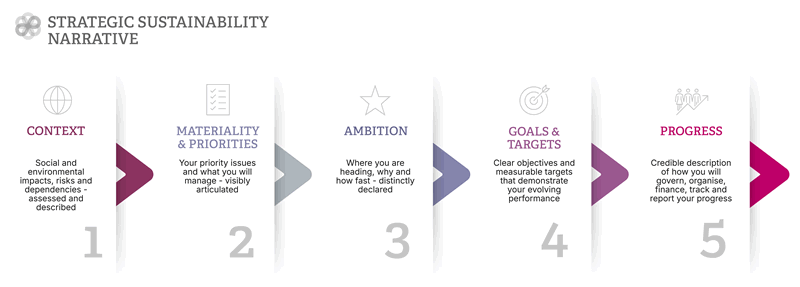
There’s two parts to our suggested stress test. Can you answer yes to the two following questions about communicating your sustainability strategy and performance?
A. NARRATIVE
Have you got:
- 1. CONTEXT | Assessed and described your social and environmental impacts, risks and dependencies.
- 2. MATERIALITY & PRIORITIES | Articulated your priority issues and what you will manage
- 3. AMBITION | Described where you are heading, why and how fast
- 4. GOALS & TARGETS | Published clear goals and measurable targets that demonstrate your performance
- 5. PROGRESS | Described how you will govern, organise, finance and report progress?
B. EVIDENCE
If you have all the above, now consider, can you communicate your strategy and performance using figures that you could defend in front of a:
- Regulator
- Auditor
- Your largest/most important customer
… what would you still say?
Whatever survives that this template is your sustainability story. Whatever does not is likely either a weakness in the narrative or a weakness in the evidence.

 Carbon Neutral Claims and Communications