
Greenwashing is increasing in volume and exposure. As the value of making environmental and social claims rises, so does the volume of bad or careless practice. Much of it is unintended, but intended or not, it carries real consequences for company reputation, trust, and credibility.
Are you struggling with greenwashing in your business? Hire the experts!
As an independent sustainability consultancy, we help organisations plan and perform more sustainably, and develop claims and communications that are reliable, defensible and clear. If you’re struggling with navigating greenwashing in your business and need a strategy that will help you steer clear of the wrong messaging, talk to Terrafiniti today.


ON THIS PAGE
This page explains what greenwashing is, why it happens, the forms it takes, the risks it creates, and how to avoid it. It’s a complex topic and there’s a lot of content, use these links to find you way around.
Why is greenwashing increasing? >>
The types and signs of greenwashing >>
Greenwashing buzzwords – a deeper dive >>
The risks of greenwashing, and who is exposed >>
A framework for understanding greenwashing compliance risk >>
What is greenwashing?
Greenwashing is where meaningless or unsubstantiated claims, deliberately or accidentally, mislead people into believing that a company’s performance, products or services are more sustainable than they really are.
It usually takes the form of claims about environmental performance or outcomes made without sufficient context, evidence or proof.
Sometimes called ‘green sheen’, greenwashing can arise from overenthusiasm just as easily as from a conscious attempt to deceive. As awareness of climate change, nature loss and other global challenges grows, both consumers and corporate buyers increasingly want to make informed choices about the things they buy, and that demand creates pressure to make claims that aren’t always entirely accurate.
Crucially, greenwashing is not only the preserve of bad actors. Organisations can become overzealous in their sustainability communications without ever meaning to mislead, for example, publicly committing to emissions reductions on unrealistic timeframes. This kind of well-intentioned overreach can harm a business in ways it never anticipated, and it is no less corrosive to a sustainable future than a deliberate smokescreen. A larger marketing budget does not make a company more sustainable; it simply allows it to make more environmental ‘noise’
Where the term comes from
The word was coined in a 1986 essay by the environmentalist Jay Westerveld, who criticised the hotel industry for promoting towel reuse as an environmental measure when its real purpose was to cut laundry costs. That tension, between what a claim says and what actually motivates it, sits at the heart of greenwashing to this day.
Feel good, or feel true?
The fundamental question is a simple one, is a claim about a product or service true and meaningful in the context of reduced environmental or social impact? Or is it merely marketing with little or no substance behind it? A claim becomes greenwashing when it is untrue, irrelevant, or designed to create an impression of performance that isn’t supported by the facts.

Greenwashing and related terms
A handful of related terms are often used alongside, and sometimes confused with, greenwashing. It’s worth being clear about the differences.
Whitewashing. Where greenwashing involves falsely claiming environmental benefits, whitewashing is the deliberate concealment of unpleasant or incriminating facts about an individual or organisation.
Greenhushing is, in many ways, the opposite of greenwashing: deliberately downplaying or withholding information about genuine sustainability work. Companies do this to avoid criticism, political controversy, or accusations of greenwashing, or because they judge their progress too modest to promote. Ironically, a climate of distrust created by greenwashing tends to encourage greenhushing, as organisations grow nervous about putting their heads above the parapet.
Astroturfing, named after the synthetic grass surface, is the practice of disguising the true promoter of a message or campaign to make it appear to represent genuine grassroots opinion. Often a tool of political manipulation, it has been used as a niche form of greenwashing, particularly around social issues.
Green marketing is not the same as greenwashing. It is perfectly possible to develop and sell products with genuinely reduced impacts or more positive characteristics, and to say so accurately and truthfully. Greenwashing is effectively green marketing done badly, whether through a lack of knowledge or a deliberate intent to mislead.
Why is greenwashing increasing?
There are several reasons, but two major drivers stand out.
Market-led motivation
A growing number of consumers and organisations want to buy products and services that deliver higher relative levels of environmental or social performance. Companies see this demand as an opportunity for differentiation – and often as a way to charge a premium. That, in turn, increases the pressure on brand and marketing teams to make the strongest possible case, which is precisely where overreach creeps in.
Avoiding change
Few people or organisations relish change; it is difficult, complex and slow. Many examples of greenwashing are simply over-extended claims built on small, incremental product changes, like the inclusion of some recycled material in a product. NGOs argue that greenwashing is frequently used to create the illusion that change is happening when it isn’t. For high-impact sectors driving significant environmental damage, this can act as a distraction or smokescreen for business as usual. More often, it can be about exaggeration, the inclusion of some recycled content in my product makes it ‘sustainable’. Spoiler alert – it doesn’t.
The types and signs of greenwashing
While some words signal the risk of greenwashing, no single word is inherently greenwashing, use and context is always important. But there are recognisable patterns, and once you know what to look for, they become difficult to unsee.
The ‘Seven Sins of Greenwashing’
In 2007, the environmental marketing firm TerraChoice (now part of UL) characterised the common forms of greenwashing as the ‘Seven Sins’. They remain a useful diagnostic frame which has been adopted by various regulators worldwide:
1. The Hidden Trade-off – promoting one ‘green’ attribute while ignoring other, more significant, impacts.
2. No Proof – a claim that can’t be substantiated by accessible supporting evidence.
3. Vagueness – a claim so broad or poorly defined that it’s likely to be misunderstood (‘all natural’, ‘eco-friendly’).
4. Worshipping False Labels – implying a third-party endorsement or certification that doesn’t exist, or that means little.
5. Irrelevance – a claim that may be true but is unimportant or unhelpful (for example, ‘CFC-free’ for a product where CFCs are already banned).
6. Lesser of Two Evils – a claim that’s true within a product category but distracts from the greater impact of the category itself.
7. Fibbing – claims that are simply false.
Each of these is a form of dissembling, an outright untruth, or a half-truth that conveys an impression which can’t be justified. They map onto three fundamental types of greenwashing.
Type 1: Just plain lying
This can take several forms. Claiming standards or certifications that haven’t been earned, or falsifying audit documentation to support them. Because certified goods often command higher prices, there is a direct financial incentive to ‘certify’ a shipment of cocoa, cotton or coffee by fiddling the paperwork.

The most notorious recent example is Volkswagen’s emissions-cheating programme, which fitted vehicles with software designed to [cheat emissions testing](https://www.driving.co.uk/news/vw-suffers-hit-ongoing-dieselgate-scandal/) – allowing non-compliant, dirty vehicles to pass regulatory tests. ‘Dieselgate’ did lasting damage to trust in both diesel and the manufacturers involved. Referencing a label that doesn’t exist, or one that requires no meaningful change, falls into the same category.
Type 2: Misdirection
Most greenwashing involves some form of misdirection, and it deserves its own category because some of it could be construed as making genuinely true claims from a position of partial ignorance. The overall result is misdirection and untruth, but the motive can be murkier, or relatively benign.
Typically, it means being selective, making bold claims about specific positive attributes while quietly ignoring the less palatable ones. Where the negatives manifestly outweigh the positives, you have classic misdirection. A few illustrations:

The SUV. You could claim your latest model is 26% more efficient than another SUV.
It’s a shame – that this might still mean 24 miles per gallon versus 19, and that neither is remotely efficient compared with most other vehicles.

The bottled water. Your bottle is ‘sustainable’ because the PET uses less plastic than a competitor’s and includes 20% recycled content.
The bottled water. Your bottle is ‘sustainable’ because the PET uses less plastic than a competitor’s and includes 20% recycled content.

The olive oil soap (pun intended). The packet looks homely and rustic (and green), it highlights locally sourced olive oil.
It’s a shame – that there’s only a few percent olive oil in the recipe, the bulk of which is palm-oil-derived or petrochemical, alongside more water than olive oil and ingredients that are toxic to aquatic life.

The bamboo socks. Sustainable, because bamboo is fast-growing and needs no pesticides or irrigation.
It’s a shame – that the bamboo is grown in China with a large transport footprint, and processed using carbon disulphide, which is highly toxic to workers and the environment.
Type 3: Meaninglessness
Some claims have no inherent meaning at all.
Environmentally friendly
Nothing that isn’t actively contributing to the health and diversity of the environment is genuinely ‘friendly’. Some things are less bad, none are friends. It’s rather like calling low-tar cigarettes ‘lung-friendly’.
All natural / chemical-free
Natural things aren’t necessarily safe (many poisons are entirely natural), and everything in the world is made of chemicals.
Biodegradable
An often-abused term. It has real definitions, but its value depends on whether a substance actually degrades in real-world conditions, and crucially, what it degrades into. Some compounds biodegrade into other toxic substances.
Examples of greenwashing
Above, we have covered the context and principles of greenwashing, but it’s also valuable to look at real cases. The detail of specific rulings, and the running list of new ones, is on our [Greenwashing News](https://www.terrafiniti.com/greenwashing/greenwashing-news/) page, but a few recurring patterns are worth exploring.
Whole-sector implausibility
Airlines have repeatedly had ‘sustainable’ and ‘protecting the future’ claims banned, because regulators hold that there are currently no commercially viable technologies that could substantiate an absolute green claim (e.g. ‘sustainable) for aviation. You cannot make an absolute claim for an inherently high-impact industry.
Misdirection by scale
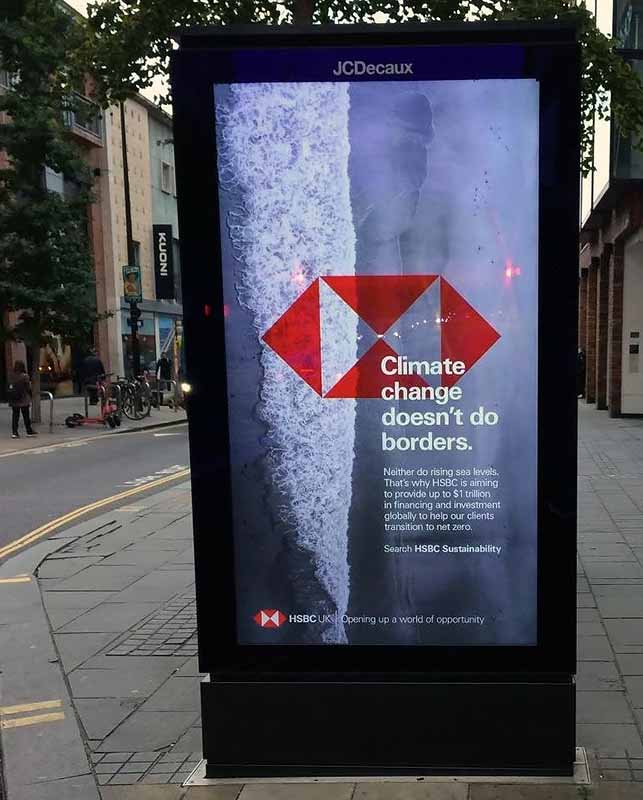
Banks and other financial institutions have had advertisements banned for highlighting specific green initiatives while omitting the far larger emissions associated with their wider lending and investment. The omission of that material context is itself misleading.
‘Eco’ ranges and loose product claims
Fashion and FMCG brands have faced investigation and enforcement over vague ‘sustainable’ ranges, unclear recyclability and use of ‘natural’-looking imagery, prompting formal commitments to describe environmental credentials clearly, specifically and accurately.
Unsubstantiated general/absolute claims from well-meaning brands.
Even smaller companies genuinely trying to do the right thing have had ‘sustainable’, ‘eco’ and ‘biodegradable’ claims banned where the evidence didn’t specifically underpin the explicit claim, or failed to provide good enough evidence for the scale of the claim. a reminder that good intentions and general credentials are not a substitute for claim-specific proof. See the framework for understanding greenwashing compliance risk >>
Greenwashing buzzwords – a deeper dive
Some words appear repeatedly in misleading communications. None is necessarily ‘greenwashing’ in isolation, but use of these is frequently a warning sign.
Natural

A top-ten greenwashing term in our own research (including variants like ‘nature positive’ or ‘nature’s choice’). Without context it means very little. It trades on two assumptions, that ‘natural’ means ‘safe’, and that proximity to nature is inherently good, neither of which is reliably true.
Death caps, deadly nightshade, arsenic and radioactivity are all entirely natural. Peat, wild-harvested species, uncertified timber and conventionally grown cotton are ‘natural’ and carry serious sustainability impacts. Without information on safety, toxicology and supply-chain impact, ‘natural’ is effectively meaningless.
Bio
Found in ‘bio-based’, ‘biodegradable’ and ‘bio-material’, it evokes cleanliness and low impact. But a bio-based product may still be non-biodegradable, energy-intensive to produce, or implicated in deforestation and land-use change. This prefix is not a sustainability credential.
Green
Perhaps the most used and least defined term of all, green energy, green finance, green buildings, green jobs. There is no universal definition, certification or benchmark, which makes it highly flexible and highly prone to misuse. A ‘green’ cleaning product may still contain harmful chemicals, a ‘green’ fund may hold fossil-fuel shares. Use of the colour alone, a leaf on the packaging, is enough to nudge a subliminal impression of responsibility. Being ‘less harmful’ than a conventional option does not make something ‘sustainable’.
Recycled
Generally speaking, having recycled content (or the ability to recucle a product at end-of-life) is a ‘good’ thing. It is increasingly expected, and increasingly diluted. ‘Recycled’ may describe a product that is only 10% recycled content and 90% virgin material, therefore greenwashing by omission. The type of recycled content is also important. Pre-consumer (manufacturing offcuts that never reached a user) carries far less environmental value than post-consumer (genuinely diverted from waste). To be trustworthy, a recycled claim should state the percentage, the type, which component it applies to, and a valid verification scheme.
Sustainable, Eco
Probably the top greenwashing term, sustainable is frequently misunderstood. This is partly due to common language usage, where it’s become a synonym for something that’s less damaging to the environment or people than other alternatives. If you look at definitions of sustainability, you can see this is incorrect. But definitions aside, it matters because regulators treat the terms ‘sustainable’, ‘eco’ as general/absolute claims. In recent rulings, the ASA has reaffirmed that consumers would interpret claims of ‘sustainable’ or ‘eco’ as meaning the product is either beneficial for, or at least not detrimental to, the environment. In practice, this is almost impossible to substantiate.
The kind and ‘friendlies’
Typically seen as ‘environmentally friendly’, ‘climate-friendly’, or ‘kind to the planet’. These terms are a mixture of meaninglessness and general/absolute claims. If your product is claimed to be ‘kind to the planet’ be prepared to prove that at the very least, it causes no harm across the entire lifecycle.
The regulatory landscape
Regulators worldwide are tightening their positions, and there is a surprising degree of consistency in what they consider misleading. The detail evolves constantly – for the latest enforcement actions and rule changes, see our [Greenwashing News](https://www.terrafiniti.com/greenwashing/greenwashing-news/) page – but the underlying framework is stable.
United Kingdom
The three main bodies tackling greenwashing in the UK are the CMA, ASA and the FCA. They work together closely, and convergence across the three means that if a claim that fails one framework it is increasingly likely to attract scrutiny from the others.
Competition and Markets Authority (CMA)
The CMA is the consumer-protection regulator, and its central piece of guidance is the Green Claims Code (published September 2021), designed to help businesses comply with consumer protection law.
The CMA’s powers were significantly strengthened recently: under the Digital Markets, Competition and Consumers Act, since 6 April 2025 the CMA can directly investigate, require undertakings, order remedies, and fine firms up to 10% of global turnover for misleading environmental claims, without going to court. It has increasingly used technology to sweep online communications for potentially misleading green statements across consumer-facing sectors.
Advertising Standards Authority (ASA)
The ASA is the UK’s independent advertising regulator. It administers the requirements for advertising under the UK Code of Non-Broadcast Advertising and Direct and Promotional Marketing and the UK Code of Broadcast Advertising (the CAP and BCAP Codes), and its guidance helps firms interpret those rules on environment-related advertising. It polices misleading green claims in ads, though unlike the CMA and FCA its enforcement powers are more limited (it relies largely on rulings and referrals rather than fines). ASA research has found widespread public misunderstanding of environmental terminology, so the burden falls on the advertiser to ensure communications are clear. Similar to the CMA, it has revealed that it’s using AI to screen ads, web pages and digital/social advertising. The ASA will act on a single complaint and we’re seeing these being raised by consumers, competitors, charities and activist groups.
Financial Conduct Authority (FCA)
The FCA regulates greenwashing in financial services. Its anti-greenwashing rule came into effect in May 2024, and related “naming and marketing” rules began to apply in December 2024. These are part of the FCA’s Sustainability Disclosure Requirements (SDR) and investment labels regime, designed to prevent investment firms from overstating the green credentials of their products to customers. Notably, the rule is broad, it applies to all FCA-authorised firms making any sustainability claims about any product or service, not only investment products with sustainability objectives.
European Union
The EU’s approach is based upon two main layers with a third planned layer currently stalled. The baseline is the Unfair Commercial Practices Directive (UCPD), which prohibits misleading environmental claims as a form of unfair commercial practice. Building on that, the EU adopted the Empowering Consumers for the Green Transition Directive (ECGT) in March 2024, and applies from September 2026. It bans generic green claims and offset-based product “climate neutral” claims across the EU. The proposed Green Claims Directive (GCD) was intended to add detailed substantiation and third-party verification requirements to claims, but it has effectively stalled politically and whether it will ever be adopted remains uncertain.
United States
While the EU and UK are tightening requirements, the picture in the US picture is almost the mirror image, with a pullback at the federal level, combined with active state-level and private enforcement. Federally, the main tool is the FTC’s Green Guides, issued under the FTC Act to flag deceptive green marketing. But these were last revised in 2012, and the long-awaited update has stalled. The SEC’s (Securities and Exchange Commission) proposed climate-disclosure rule (first floated in 2022) has likewise lost momentum under the Trump administration. At a state level, California has multiple laws, with New York and Washington also tightening their rules. In addition, private litigation, class action lawsuits targeting misleading sustainability marketing have increased, with high-profile cases such as New York’s attorney general suing JBS over climate claims and litigation over “carbon neutral” labelling on Evian water.
A consistent direction?
With the exception of the US at a Federal level, the focus across many jurisdictions is becoming more strategic. Rather than only testing whether a single claim is clear and substantiated, regulators increasingly assess claims against a company’s overall performance and its plausible ability to deliver. A ‘sustainable aviation’ claim, for instance, fails not on the wording alone but because the sector as a whole cannot currently substantiate it. This wider test of plausibility aligns more closely with what the public understands greenwashing to mean.
The Green Claims Code
The Green Claims Code is the CMA’s guidance for businesses making environmental claims, published in September 2021 to combat greenwashing and protect consumers from misleading green marketing. The scope is broad, it applies to advertising and any product or service, by any commercial entity, aimed at or supplied to a UK consumer, including non-UK businesses, distributors and online platforms.
At its heart are six principles, claims must:
- Be truthful and accurate.
- Be clear and unambiguous.
- Not omit or hide important relevant information.
- Make fair and meaningful comparisons.
- Consider the full lifecycle of the product or service.
- Be substantiated.
The Code provides guidance on the law and aims to prevent businesses from profiting from misleading claims about their products’ environmental impact, while also protecting honest businesses from unfair competition and creating a level playing field. Under the UK Digital Markets, Competition and Consumers Act, the CMA has real teeth and can directly fine companies up to 10% of global turnover for misleading claims.
In practice, the CMA has used the Code it actively, opening investigations into fashion businesses ASOS, Boohoo and George at Asda, boiler manufacturer Worcester Bosch, and consumer goods group Unilever. It also works closely with the other regulators in the UK, integrating their approaches and sharing intelligence. While specific requirements vary in other international jurisdictions, the Green Claims Code provides a very useful guide to common good practice.

Greenwashing News
News, updates and notable developments in greenwashing, including regulatory action and commentary on what you need to know to reduce your communication risks and concentrate on your valuable message.

Communicating future ambition and net zero – how to avoid greenwashing
Clear, credible communication of future sustainability ambitions is essential for building trust and avoiding accusations of greenwashing. This article explores how organisations can articulate long-term goals without overstating progress, by …

Carbon Neutral Claims and Communications
Carbon neutral claims remain common, but they are increasingly risky. This article explains why the term is often misunderstood, how it differs from net zero, what UK and EU regulators expect, and how businesses can make clearer, more defensible …
The risks of greenwashing, and who is exposed
Greenwashing can seem merely irritating. In fact, it causes a range of harm and creates multiple business risks, not only for the company that communicates a claim, but for those who help create it and those associated with it. It has traditionally been linked to marketing and sales, but it increasingly arises from strategic corporate communications and formal sustainability reporting too.
The most significant risks fall into two overlapping areas.
Regulatory risk
Communications that breach regulatory codes can result in banned adverts, fines and censure. The CMA now has extensive and growing powers in this area. This is prominent, but tends to be the shorter-term risk.
Reputation and brand risk
Potentially much larger, because more is at stake and the impact is longer-lived. Reputation is largely intangible but hugely valuable, and often closely tied to sustainability performance, which is precisely why greenwashing, or even the perception of it, puts it at risk. Awareness of this exposure remains surprisingly low.
Who are the stakeholders?
Greenwashing risk runs across the value chain. The relationships can be summarised as follows.
Table 1. Greenwashing risk routes and relationships
| STAKEHOLDER | PRINCIPAL RELATIONSHIPS & INTERESTS |
| Regulators; CMA (UK), ASA (UK) EC (EU), FCC (US) | Protecting the interests of consumers and businesses, market integrity, focus on communications and behaviour of the ‘the company’. |
| Consumers / Customers (B2B) | Environmental and social performance of the company and the relative perceived merits of its products or services. |
| NGOs / activists | Pursuing their agendas, calling out examples of bad practice/perceived malfeasance in companies –their partners or suppliers. |
| Investors | ESG performance and risk to investment judgements for ‘the company’ which may already be held or is an investment prospect. |
| Company suppliers | Providing materials/labour/finished goods – a source of potential risk to their customers via their activities and material sourcing. |
| Creative/professional services suppliers to companies | Providing services (marketing, communications, advertising, sustainability). Source of potential risk to ‘the company’ in greenwashing through advice/content development. |
| The ‘company’ | Interested in protecting its reputation, avoiding regulatory action. Source of potential risk by association to creative/professional agencies, services companies and investors. |
Challenges for companies
Managing greenwashing risk means focusing on sustainability performance across the entire value chain, tightly integrated with all sustainability-related communication. This also extends to the performance of suppliers, including the creative agencies that support external messaging. Calculating the level of risk is complex. Severity depends on factors including the perceived magnitude of the problem, how many people are affected, its duration, the ability to take (and visibly demonstrate) mitigating action, and whether something similar has happened before. The risks that matter most are often the ‘long-tail’ ones, low likelihood, high impact, which can be particularly damaging.
Challenges for the creative industries
Many agencies are alert to some of the reputational risks, but these run in two directions, the risk of creating copy and campaigns that breach the rules, and the risk of working for a client whose wider behaviour represents a risk by association. The [Clean Creatives](https://cleancreatives.org/about) initiative, whose pledge commits agencies and strategists to refuse future contracts with fossil-fuel companies and front groups, is a clear sign of part of the industry calling out greenwashing and also its own possible complicity in it.
Risk-perception gaps
A risk-perception gap is the distance between a measured assessment of risk and the level perceived by those involved. We see several recurring ones:
1. Awareness and understanding
It’s widely understood that poor performers are exposed when they overclaim. Far less recognised is that good performers can also breach the rules – the compliance-failure trap described above.
2. Focus
Many companies see greenwashing only through the lens of marketing and corporate communications, rather than the underlying sustainability performance (and disclosure) of the organisation.
3. Responsibility
Some agencies assume the risk lies entirely with the client, that if the client signs off non-compliant copy, the agency has nothing to worry about. This is a short-sighted and short-term view. Others are finding that taking a more responsible approach is seen as valuable by clients.
4. Materiality
Materiality, focusing on the issues that genuinely matter, is core to sustainability and to greenwashing, yet often poorly observed. If you screen a claim or a client only on carbon, how will you spot child labour, human rights abuses, modern slavery, toxics, biodiversity loss or habitat destruction? A partial assessment leaves material risks unexamined.
5. Reliance on standards
Certifications can provide robust third-party assurance, but only if they are robust. Where a label is weak, or perceived as weak, advertisers relying on it can find that its value shifts from substantiation to greenwashing. Advertisers are required to hold up-to-date, relevant evidence, a label that fails to provide it offers no protection.
Managing greenwashing risks
No risk can be removed entirely, but awareness coupled with action can manage and mitigate it. If we revisit our table exploring the routes to risk, we can look at the management responses available to companies and their suppliers.
Table 2. Possible greenwashing risk management responses
| RISK FROM | RISK TO | ROUTE / RISK | MITIGATION |
| Regulators | Company | Direct / Fines/regulatory action Indirect / Damage to brand reputation. | Improve material performance. Ensure claims match performance and meet codes. |
| Regulators | Creative/professional agencies/services | Direct / Fines/regulatory action (for own communications) Indirect / Damage to brand reputation (for work supplied). | Direct / Most risk to the company through divestment or access to/cost of capital. |
| Consumers | Company | Indirect / Risk through complaints to regulators Direct / customer boycotts Indirect / Damage to brand reputation. | Improve material performance. Ensure claims match performance and meet codes. |
| NGOs / activists | Company | Direct / Most risk to brand reputation via adverse media. | Improve material performance, genuinely manage issues. |
| NGOs / activists | Creative/professional agencies/services | Direct / Most risk to the company through divestment or access to/cost of capital. | Screen customers. |
| Investors | Company | Direct / Most risk to the company through divestment or access to/cost of capital. | Improve material performance. Accurate, transparent and material disclosure. |
| Company suppliers | Company | Direct potential risk from activities, finished goods and materials supplied. | Improve supply chain performance. Screen suppliers and performance manage. |
| Creative/professional services suppliers to companies | Company | Direct potential risk from creating greenwash advice or content. | Screen suppliers and performance manage. |
| Company | Creative/professional agencies/services | Indirect Risk from association. | Screen customers. Engage with and support customers. |
Two broad areas of activity follow from the analysis above, performance improvement and compliance of communications.
Performance improvement includes understanding your strategic context and actual impacts, assessing materiality, setting long-term goals and targets on the issues that matter, disclosing progress credibly and transparently, engaging stakeholders and finally review and improvement.
Compliant communications means ensuring that any copy or claim meets regulatory standards and requirements. Typically, this involves using precise language, applying sound logic (telling the whole story, not a flattering portion), and is backed by timely, relevant evidence.
These two levels cannot be separated.
The Responsible Communications Iceberg illustrates how responsible communications rely upon underlying business approaches and performance. Building trust, credibility and authenticity requires these underlying structures and delivery.
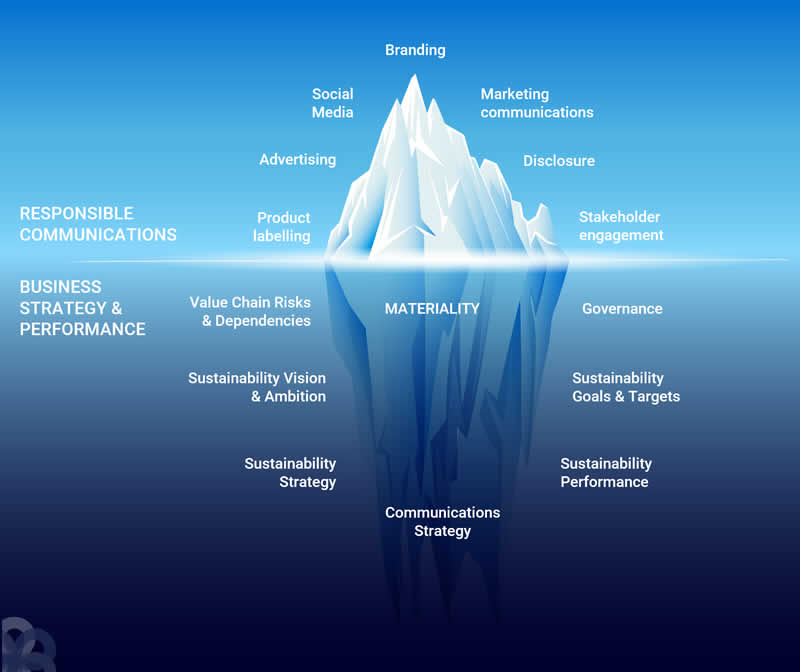
Without meaningful strategy and verifiable performance, a company has a very shaky foundation for any claim at all. Even strong performers can fall foul of the regulators if they fail to comply with the relevant codes.
As a sustainability & ESG consultancy, we specialise in helping companies and organisations plan and perform more sustainably and help develop more responsible and reliable claims and communication. Our services can help you spot and avoid the risks of greenwashing.

A framework for understanding greenwashing compliance risk
Many conversations about greenwashing focus on the most obvious or high-profile cases. These might include the airline claiming sustainable aviation, the fast fashion brand with an unsubstantiated ‘eco range’ or the bank advertising its green investments while quietly financing fossil fuels. These types of examples make headlines, attract regulatory attention and provide useful cautionary tales.
But they can also create a misleading impression, one that greenwashing is primarily a problem of cynical intent, and that well-meaning organisations with genuine sustainability commitments are largely safe. However, neither of those things is true.
In our experience working with companies across diverse sectors for more than 25 years, the organisations caught out by greenwashing regulators are more often confused (in the nicest possible way) than dishonest. These companies have sustainability ambitions, they communicate them, and somewhere between intent and execution, they fall foul of rules they didn’t fully understand. A 2025 Which? study found that 62% of products assessed failed checks against the CMA’s Green Claims Code, including many from companies that position sustainability as a core value.
This points to a more uncomfortable truth, greenwashing risk is structural, not just behavioural. It arises from a gap between sustainability performance and communications compliance. To make that clearer, we map company positions across two axes, the strength of underlying performance, and the compliance quality of communications. Four very different stories emerge.
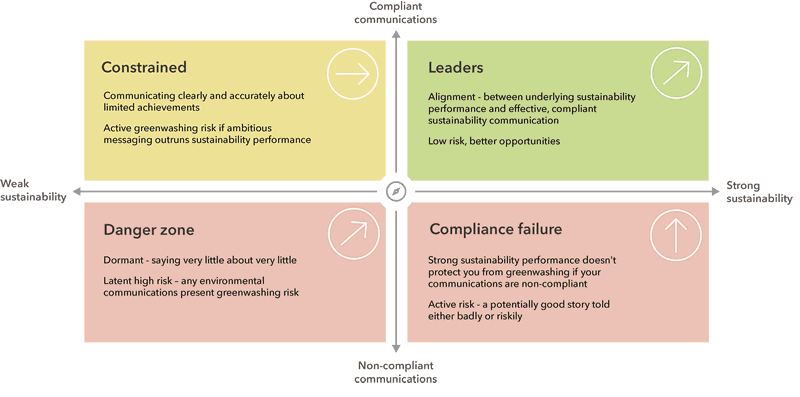
Leaders
Companies with strong sustainability performance and compliant communications are the leaders. Their claims are substantiated, their evidence is solid, and their messaging accurately reflects their achievements. This is the only genuinely safe position.
Constrained
Companies with weak sustainability performance but good communications compliance sit in a constrained position, communicating clearly and accurately about limited achievements. This is not inherently dishonest, but it carries active risk if messaging ambition starts to outrun actual performance. Their reach could easily exceed their grasp.
Danger zone
Companies with weak performance and poor communications are in the danger zone. Those saying very little about very little may simply be dormant, where they are not greenwashing, but nevertheless accumulating latent risk. Those that do communicate, however, face high exposure. Any environmental claim made without substantiation in this position is greenwashing risk in its most concentrated form.
Compliance failure
The fourth position is perhaps the most counterintuitive and the most important for sustainability and marketing professionals to understand. Companies with strong sustainability performance but non-compliant communications are experiencing compliance failure.
The critical insight for these companies is that strong sustainability performance does not protect you from greenwashing if your communications are non-compliant.
The compliance failure position is the one that catches the most well-intentioned organisations. A company may have invested substantially in reducing its environmental impact, built genuine supply chain transparency, and have a credible long-term strategy. But if it describes its products as “sustainable” or “eco-friendly” or similar, it is still greenwashing in the eyes of regulators. This is because in recent rulings the ASA has reaffirmed it considers that consumers would interpret claims of “sustainable” or “eco” as meaning the product about which it was made was either beneficial for, or at least not detrimental to, the environment. This stated consumer interpretation test is the critical obstacle here. This creates a structural problem for companies that no amount of good evidence or LCA (life cycle assessment) data can fully resolve. The issue isn’t the quality of the evidence, it’s that the claim “sustainable” sets a consumer expectation that the evidence, however excellent, cannot meet if there are any adverse environmental impacts.
The ASA’s recent (February 2026) Kit & Kin and Cheeky Panda rulings illustrate this precisely. Both companies were, by several measures, genuinely trying to do the right thing. Both used language that their sustainability credentials might have entitled them to support.
However, the ASA disagreed, ruling that evidence must underpin explicit claims specifically and completely, not just provide a general halo of good intent. As we noted in our analysis of those cases, the CMA has reiterated in its 2026 guidance on green claims and supply chains that having good intentions does not constitute a valid legal defence.
The asymmetry of improvement
There is an important practical implication in this framework. Moving up the vertical axis (improving communications compliance) is genuinely faster and more achievable than moving to the right on the horizontal axis (transforming underlying sustainability performance).
Structural sustainability improvement takes time. It requires changes to strategy, supply chains, products and processes. It cannot be done quickly and credibly.
But communications compliance can be addressed much more immediately through understanding the Green Claims Code, auditing existing claims, removing unsupported absolute statements and building a sound, defensible evidence base for the claims you do make, all of which should be wrapped up in an accountable business process.
These are not small tasks, but they are achievable ones. The CMA is clear that having no processes in place to ensure communications accuracy is itself “particularly egregious” in the event of an investigation.
Good intentions matter morally, they do not matter legally
The companies best placed to navigate this landscape are those that have closed the gap between what they do and how they describe it. Not by doing less, but by communicating with clarity, specificity and evidence. The CMA has been explicit that good intentions do not constitute a valid legal defence. That is responsible communication, and it is not optional.
How to make valid claims and avoid greenwashing
If there are so many ways to get it wrong, how do you get it right? The UK Government’s [guidance for environmental claims](https://www.gov.uk/government/publications/make-a-green-claim/make-an-environmental-claim-for-your-product-service-or-organisation) offers the simplest test. Legitimate claims are:
- Clear
- Accurate
- Substantiated
To these headlines we’d also add some considerations about approach and how you develop claims.
Consider relative claims to absolute ones
Buying almost anything has a greater environmental impact than buying nothing. So, for most claims to be legitimate, they need to be ‘relative’ rather than ‘absolute’, produced with lower impacts than the average, rather than ‘sustainable’. Such nuanced claims are less exciting from a marketing perspective, but far more defensible. Any relative claim must rest on a clear, transparent evidence base, which is where tools like life cycle assessment (LCA) and product or process footprinting earn their place, providing definitive numbers with explicit assumptions and boundaries.
Communicate complexity honestly
Sustainability choices are often complex, nuanced and full of trade-offs between ‘less bad’ options. There’s rarely room on a pack or advert to list every caveat and study. This is why recognised ‘eco-labels’ are so widely used, and why the Green Claims Code allows supporting detail to be held off-pack (via a QR code or website). For some products – particularly those from biological resources – a single carbon figure tells only part of the story, and information on farming practice, biodiversity and labour conditions matters too. Remember that good communication shouldn’t raise more questions than it answers.
It’s strategic and tactical
Avoiding greenwashing operates at two levels that cannot be separated. Strategically, without a meaningful overall approach and verifiable performance, a company has no sound foundation for any claim. Tactically, even companies with good underlying strategies can still breach the rules if their communications don’t comply with the relevant codes. The organisations least likely to be accused of greenwashing are those that understand where the risks lie and take a careful, compliant and strategic approach to managing them.
To that, we’d add five useful habits of mind for assessing any message, whether it’s one you’re reading or one you’re about to publish:
- Be sceptical. Put yourself in the shoes of a critic, could you defend the assertion if challenged?
- Be self-critical. Imagine a competitor, an NGO or a scandal-seeking journalist reading your message. Are you still comfortable?
- Be accurate. Claims must be accurate, that often means being more specific and avoiding superlative and general claims.
- Include the whole picture. It’s important that your message doesn’t ignore important aspects across the entire lifecycle.
- Stick to the facts. You must have the evidence to back claims ready before publishing.
FAQs – Frequently asked questions about greenwashing
Is greenwashing illegal?
In the UK, misleading environmental claims can breach consumer protection law and advertising codes. The CMA has direct enforcement powers and can issue significant penalties, and the ASA can ban advertisements, web page content and digital ads. So while ‘greenwashing’ isn’t a single named offence, the conduct it describes is frequently unlawful.
What’s the difference between greenwashing and greenhushing?
Greenwashing overstates, misrepresents or fabricates environmental credentials. Greenhushing is doing the reverse, deliberately staying quiet about genuine sustainability work, often to avoid scrutiny or accusations of greenwashing.
I have a responsible business and good intentions – can I be greenwashing?
Yes. If communications break the rules you can be non-compliant, even if your product/service has strong sustainability credentials. Good intent is not considered a valid legal defence.
Can a company with strong sustainability performance (i.e. a B Corp or similar) still be greenwashing?
Yes. If its communications are non-compliant, for example, using absolute/general terms like ‘sustainable’ that the evidence can’t fully support – it can be greenwashing regardless of how good its underlying performance is, even if this is best in class.
What are the most common greenwashing words?
‘Sustainable’, ‘natural’, ‘green’, ‘eco’, ‘bio’, ‘recycled’, ‘environmentally friendly’, ‘kind to the planet’ and ‘all natural’ are among the most frequently misused. None is necessarily automatically greenwashing, but each is a warning sign for risk when used without clear, specific, evidenced context.

Can we help you?
We’ve worked with companies in the UK, Europe and
beyond to avoid greenwash by developing responsible communications approaches, content and copy. Ranging from strategic corporate reporting and disclosure to brand guidelines or in-store packs, we can help you develop content that’s clear, accurate and substantiated.
Book a chat with one of our partners to explore how we might help you – there’s no obligation.